
AI that reviews your engineering docs
the way a Principal Engineer does.
Catches missing PWHT callouts, NACE class mismatches, NPSH margin shortfalls in 90 seconds instead of 90 minutes. Traceable findings, comment registers, human-supervised escalation.
Purpose-built for P&IDs, isometrics, datasheets, HAZOP registers and every deliverable that lands on a Principal Engineer's desk before an IFR/IFC gate — across piping, process, mechanical, civil and structural.
Enterprise-grade report delivered in 48 hours. Chartered-engineer sign-off included.

Founded by Kingsley Uzowulu, CEng MIMechE
21+ years across owner's-engineer & EPC roles in oil & gas. Supervises every deliverable; personally signs Piping, Mechanical, Civil & Structural.
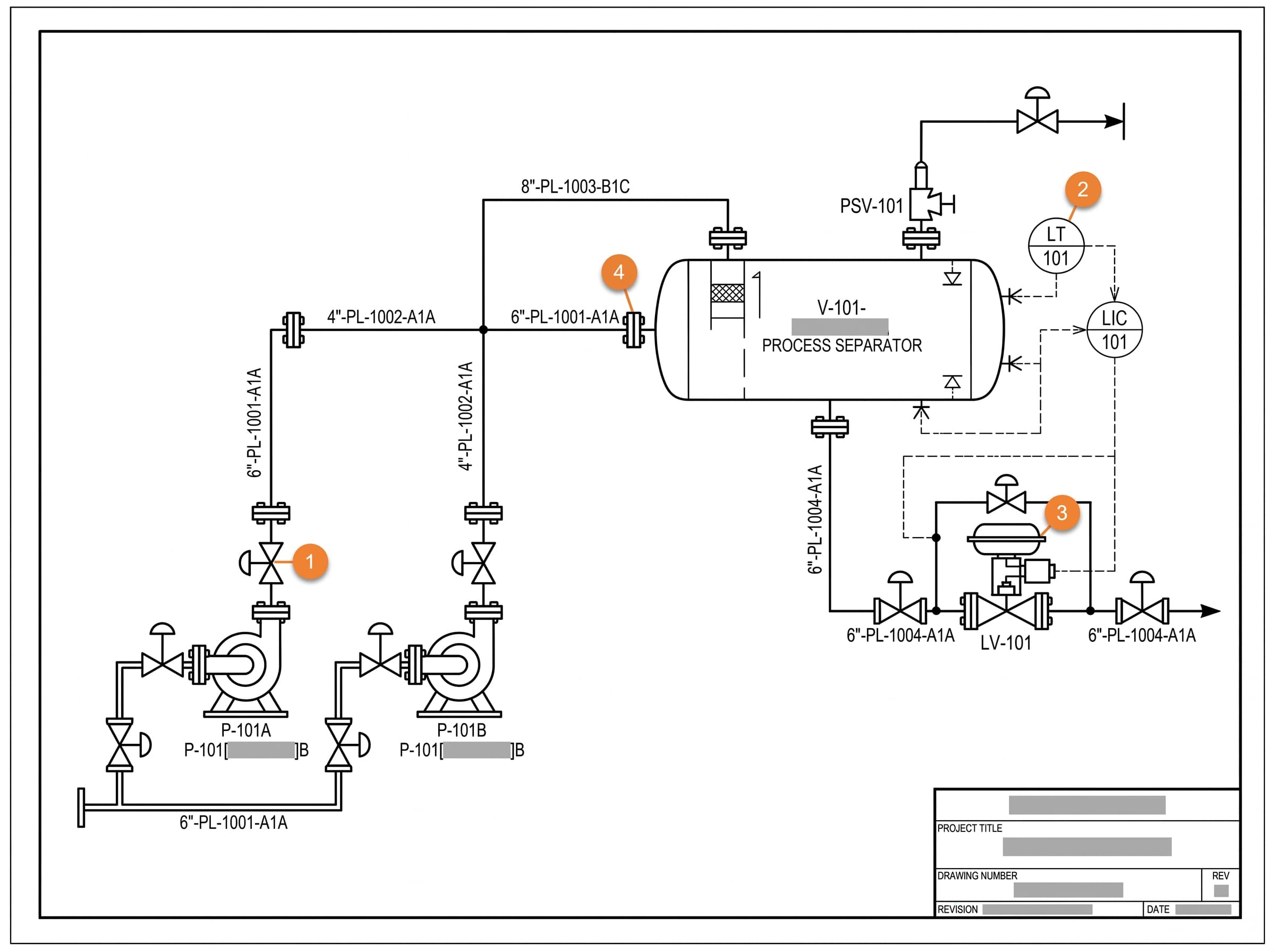
See a real supervised review (redacted)
P&ID sample pack · 8 pages →
Compressor datasheet review (API 617, redacted)
15 findings + Rev-B closeout · 8 pages →
Named CEng on every supervised deliverable
See reviewer roster →
Free benchmark for 10 named design partners
Check eligibility →
DPA, subprocessors and retention on request
Data handling →
Sample deliverable · Redacted
This is what lands in your inbox 48 hours after you upload.
Every finding cites a code clause and a drawing zone. Every register carries a chartered engineer's sign-off. No black-box AI outputs — every claim is defensible.
API 610 §6.1.14
NPSH margin insufficient at rated flow
ASME B31.3 §304.5.1
PWHT callout missing on drawing
IEC 61511-1 §11.5
SIL-2 redundancy not shown
MSS-SP-44 §5.3
Flange class verification
Pump Station · 24 Jul 2026
Evidence
Calculated NPSHa = 2.1 m vs NPSHr = 2.8 m. Margin negative. Recommend suction line upsize from 6" to 8" OR lower elevation by 1.2 m.
Clause
API 610 §6.1.14
Zone
B-3
Status
accepted
Reviewed & signed by Kingsley Uzowulu, CEng MIMechE
24 Jul 2026 · Ref SS-2026-0042
Exports supplied in your team's preferred format. IP retained by you. Findings retained for 7 years for audit trail.
Real review · Redacted
One P&ID. Eleven minutes. Twenty findings.
An anonymised excerpt from a supervised review of a pump-station P&ID. Below is the comment register your Discipline Lead would receive. Every finding cites its source clause and drawing zone.
20
Findings raised
11 min
AI review time
4
Major severity
14 / 20
Accepted by engineer
Evidence
Calculated NPSHa = 2.1 m; NPSHr = 2.8 m. Margin negative. Recommend suction line upsize from 6" to 8" OR lower elevation by 1.2 m.
Location
PID-001.1 · Rev C · Zone B-3
Engineer status
accepted
Redacted excerpt from a real supervised review. Findings, tags and clause citations are indicative of the format supplied on delivery.
Your standards · Not generic ones
Your reviewer knows Shell DEP, Aramco SAES and ADNOC AGES.
Because you uploaded them.
Every finding is cross-referenced against your project standards, not just the public codes we ship with. The AI is instructed to treat your uploaded documents as authoritative for the project — baseline codes only apply where your docs are silent.
Up to 6 document kinds
Company standard (Shell DEP · Aramco SAES · ADNOC AGES · BP GIS), project spec, Basis of Design, owner procedure, standards-override matrix, related drawing (HAZOP / C&E / SIL).
Per-project RAG
Your documents are extracted, chunked and indexed against this project only. The reviewer sees your standards before the first check runs. Retention: 30 days, then hard-deleted.
Findings cite YOUR docs
Where your standards override a baseline code (ASME, API, ISO, IEC), the finding cites your document by name and clause — not the generic code. The override is flagged explicitly.
From the review report your engineer receives:
📚 This review cross-referenced ASME B31.3, API 610, IEC 61511 and 3 of your uploaded reference documents:
- ADNOC-ES-P-01 Rev 4 · Piping engineering specification
- Shell-DEP-31.38.01-Gen · Piping general requirements
- Project-PMS-Rev-C · Piping material specification
Finding #7 (Major) — Corrosion allowance 3.0 mm shown on Line 8"-P-101 vs. ADNOC-ES-P-01 §7.3 requirement of 6.0 mm for sour service. Project spec supersedes ASME B31.3 default. Upgrade required.
Every export ships with this cross-reference block. Your Discipline Lead sees exactly which of your standards each finding traces to.
30-day retention · hard-deleted after · IP does not persist beyond the review window
Only-we-do-this
Rev B lands.
We already know Rev A.
Every engineering deliverable goes through Rev A → Rev B → Rev C → IFC. At each turn, comments get closed out — or silently dropped. SpecSense remembers every finding from the last revision and produces a closeout matrix the moment the new one arrives. Chartered-engineer sign-off included. Audit-defensible, contract-defensible.
1
Fully evidenced in Rev 0E — comment closes.
5
Some evidence, some gap. Needs Rev 0F.
12
No evidence of closeout in the new revision.
1
EPC marked closed. AI disagrees — evidence not sufficient.
- C-001CriticalRevision letter not legible in title block; owner-review stamp fields blankNo response mappedPartialEvidence in Rev 0E · Rev 0E identified with date 09.09.21 and description 'RE-ISSUED FOR APPROVAL (IFA)'. However owner-review stamp fields ‘Proj. No.’ and ‘P.O. No.’ remain blank; reviewer signature absent. Partially closed.
- C-002CriticalPDF resolution insufficient to verify revision cloud coverage‘Legibility improved’OpenEvidence in Rev 0E · The revised PDF exhibits the same resolution limitation. Magenta revision clouds now overlay additional areas but remain marginally legible at zoom. Comment does not close.
- M-004MajorLine 8"-HCV-011 flange class rated below design pressure at 320°CUpgraded to Class 600ClosedEvidence in Rev 0E · Line list, P&ID and iso all show Class 600 flanges on 8"-HCV-011 in Rev 0E. Stress engineer note added confirming thermal expansion analysis re-run. Comment closes.
- M-007MajorPWHT not annotated on P-No 5A material spool > 19mm wall‘Added to weld map’DisagreeEvidence in Rev 0E · Weld map Rev 0E shows PWHT symbol at Weld W-024 only. Spool contains 3 P-No 5A welds above threshold (W-024, W-025, W-027). EPC marked closed; AI residual action flags W-025 and W-027 still missing.
- P-011MinorSupport spacing exceeds MSS SP-69 allowable for insulated line‘Intermediate support added’PartialEvidence in Rev 0E · One intermediate support added on ISO-112 at chainage 14+200. Two further spans on same iso still exceed allowable at 3.0m. Comment partially closes.
Revision reviewed & signed by Kingsley Uzowulu, CEng MIMechE·SS-2026-0043·14 Jun 2026
Silent-drop protection.
Owners routinely lose 20–40% of Rev-A comments through revision cycles because reviewers forget which comment mapped to which fix. SpecSense doesn’t forget. Every prior finding appears in the closeout matrix or it doesn’t close.
EPC-disagreement audit.
When the EPC marks a comment ‘addressed’ but the evidence in the new revision doesn’t support closure, we flag it as DISAGREE with a clear evidence trail. That single row saves months of downstream rework and is what your client audit will look for.
Same DPI. Same reviewer. Same standard.
Human reviewers drift between revisions — different staff, different priorities, different Friday afternoons. The AI applies the same discipline library, in the same sequence, on Rev A, Rev B, Rev C. Chartered-engineer sign-off remains constant.
Why not just use ChatGPT?
An LLM produces commentary.
SpecSense produces defensible findings.
Anyone can drop a P&ID into a chatbot. What they can't do is hand the output to a client, a regulator, or an audit. Five differences that matter to the person signing the report.
- Plausible commentary — reads like an engineering opinion.Defensible findings — each cites a code clause and drawing zone.
- No memory of your client's standards or piping class specs.Codified per-client specification packs. PMS-aware from day one.
- No responsible engineer. Output cannot be signed off.Chartered Engineer supervises severity and signs the register.
- No feedback loop. Every review starts from zero.Accepted-finding data calibrates the severity model over time.
- Cannot be produced in a client audit or a project review meeting.Signed report + comment register + evidence trail. Audit-ready.
Procurement-ready
Six questions your procurement lead will ask.
All six answered here.
Forward this section to procurement before we get on a call. Every answer is contract-backed.
Which deliverable and discipline is supported?
P&IDs, piping isometrics, equipment datasheets, HAZOP worksheets, RFIs, technical bid evaluations. Five disciplines live at launch: piping, process, mechanical, civil, structural.
Which code edition and client specification governs the review?
Latest published editions of ASME, API, BS EN, IEC, ISA, NACE. Client PMS and project specifications loaded per account — reviews cite the exact edition applied.
What source evidence appears beside each finding?
Every finding shows the code clause number, quoted text, and the exact drawing zone or datasheet field where the issue was detected. Nothing is opinion.
How are confidential documents stored, processed, deleted?
EU/regional hosting on request. Encrypted at rest and in transit. Documents purged from processing within 24h of report delivery. Full DPA available. SOC 2 in progress.
What is AI-only, what is engineer-supervised, who signs off?
AI raises the register. A Chartered Engineer reviews every major severity, sets the responsible-engineer boundary, and signs the report. Scope, limitations and liability are contract-defined.
What measurable result has a real team achieved?
First cohort benchmark publishes after Pilot #1. Prospects can request a benchmark for their own deliverable during the 48-hour supervised pilot — priced £600 credited to first pack.
Buy vs. Build
Yes, you could build this internally.
You could also build your own CRM.
The model is the easy part. The moat is everything else — the discipline libraries, the accepted-finding calibration, the audit posture, the professional indemnity boundary. That's what takes 18 months and £2M to reproduce.
Disciplines
Five disciplines. Real checks. Real code citations.
Each discipline runs a codified check sequence — the same sequence a Chartered Engineer would run, at 60x the pace.
Piping
Example finding
Flange class vs. design pressure derated for service temperature.
ASME B31.3 · MSS-SP-44 · ISO 15649
See check sequence →Process
Example finding
Relief valve sizing case not annotated against blocked-outlet scenario.
API 520 · API 521 · IEC 61511
See check sequence →Mechanical
Example finding
PWHT missing on P-No 5A material above 19mm wall thickness.
ASME BPVC VIII-1 · ASME B31.3 · NACE MR0175
See check sequence →Civil
Example finding
Foundation load case combinations incomplete per soil report.
Eurocode 7 · ACI 318 · BS EN 1997
See check sequence →Structural
Example finding
Deflection check absent for cantilever beam at rated load.
Eurocode 3 · AISC 360 · BS EN 1993
See check sequence →Pricing
Priced against avoided engineering hours.
Not against tokens.
A supervised pilot is the fastest way to see the value on your own deliverable. Fee credits toward your first project pack.
Self-serve
AI-generated · Not for reliance
£49–99
with reference pack: $55–159
per review
Kick the tyres. Automated review — no engineer sign-off, not for client submission.
- One deliverable, one discipline
- Automated finding list + PDF export
- Marked ‘AI-generated, not for reliance’
- Not for client-facing use or gate submission
- Optional: attach up to 5 client standards or project specs
Supervised pilot
48 hours · CEng-supervised
£750
fixed · credited to first pack
The recommended way to evaluate SpecSense on your real work. One fixed fee, one deliverable, one gate.
- One deliverable, full supervised review
- Chartered-engineer signed report
- 30-minute technical debrief
- Full comment register + Excel export
- Credit applied to first project pack
Project pack
10–30 deliverables
£5k–12k
per project
Core initial contract. Full project deliverable review scope.
- 10–30 documents across disciplines
- Shared client standards pack
- Dashboard with prioritised register
- Engineer sign-off per deliverable
- Delivered in 2 weeks or less
Team workspace
Monthly subscription
£1.2k–4k
per month
Recurring capacity for a discipline team or project office.
- Seats + credits + project memory
- Audit trail + admin controls
- Standards library per client
- Priority engineer supervision
- Onboarding + monthly review
Enterprise
Annual · Private deployment
£24k–95k+
per year
For NOCs, majors and top-tier EPCs with security requirements.
- SSO + security review + DPA
- Regional / private data hosting
- Custom standards + client PMS packs
- Integrations with your EDMS
- SLA + on-call engineering support
All prices in GBP. Pricing anchored to avoided engineering review hours per deliverable, not to model inference cost. Free benchmarks available to the first 10 named design partners only — check eligibility.
Roadmap
AI acceleration is our supply chain.
Not our competition.
Every model release makes SpecSense stronger without changing the buyer relationship. Here's where the product goes as the underlying reasoning improves.
Today
2026
Supervised document review
LiveP&IDs, isometrics, datasheets, HAZOP. Five disciplines. Chartered-engineer signed reports.
Year 1
2027
Multimodal — 3D CAD & laser scans
RoadmapFull 3D model interrogation. As-built vs. design cross-check. Digital twin ingestion.
Year 2
2028
Live project participant
RoadmapWatches the data room. Flags issues as revisions land. Continuous review, not point-in-time.
Year 3
2029
Voice review participant
VisionJoins design review meetings. Tracks action items. Cross-checks decisions against code.
Year 5
2031
The engineering assurance layer
VisionCategory-defining product across oil & gas, aerospace, pharma, medical devices, nuclear.

Built by a Chartered Engineer
Kingsley Uzowulu · CEng MIMechE
I've reviewed 40 P&IDs a week for 21 years.
SpecSense is what I wish I'd had on day one.
21+ years across owner's-engineer and EPC roles in oil & gas. I lead Piping, Mechanical, Civil and Structural review at my firm today — those are the four disciplines I personally sign off inside SpecSense.
For everything else — Process safety, Instrumentation & SIL, Electrical — SpecSense uses a panel of Chartered Engineers of the relevant discipline. No cross-discipline overreach. No AI stamping work no human would touch.
SpecSense codifies what a good review looks like — the sequences, the severity calls, the evidence trail — so the human engineer spends time on judgment, not on hunting.
Every finding is countersigned by a Chartered Engineer of the relevant discipline. That's the moat.
Book a supervised pilot
One deliverable. Forty-eight hours.
A signed review you can hand to your client.
£600 credited toward your first project pack. If SpecSense doesn't find anything meaningful in your deliverable, you don't pay.